
Medically reviewed by: Dr. Y. N. Kumar, MD, Shri Medscan Imaging Center, Bhubaneswar.
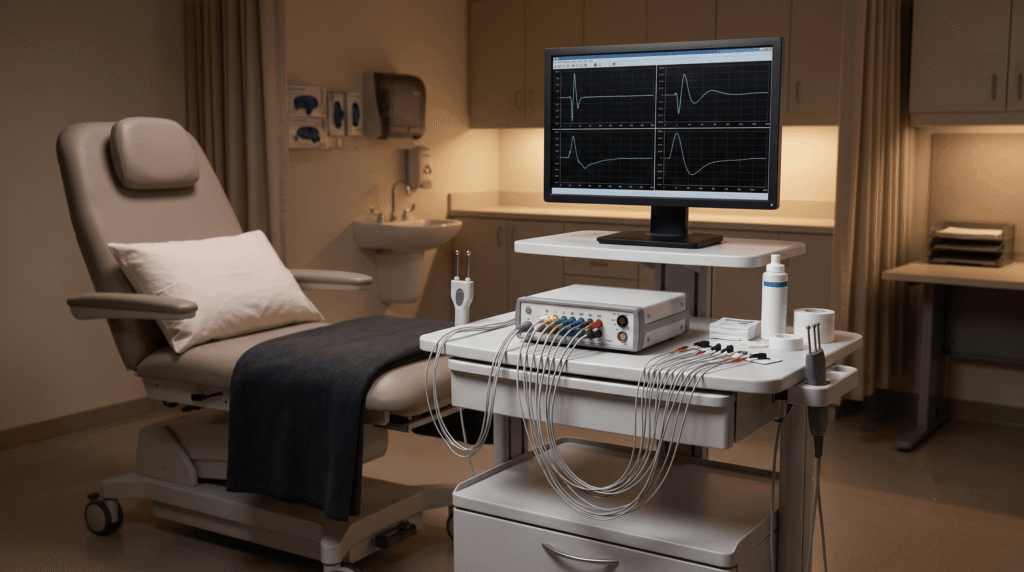
If you have been experiencing numbness, tingling, weakness, or unexplained pain in your arms, legs, hands, or feet, your doctor may order NCV and EMG tests. These two tests are among the most reliable tools available for evaluating how well your nerves and muscles are functioning.
This article explains both tests in simple terms, covers the symptoms that commonly lead to them, and describes what you can expect during the procedure.
This guide has been prepared by the neurology diagnostics team at Shri Medscan Imaging Center, a diagnostic centre in Bhubaneswar, Odisha, offering both NCV and EMG testing at two convenient locations.
What Is an NCV (Nerve Conduction Velocity) Test?
An NCV test measures how fast electrical signals travel through your peripheral nerves. Peripheral nerves are the network of nerves that connect your brain and spinal cord to your arms, legs, hands, and feet.
During the test, small electrode patches are placed on the skin above the nerve being tested. A mild electrical impulse is sent through one electrode, and another electrode records how quickly the signal reaches it. If the signal travels slowly or weakly, it may indicate nerve damage or compression.
The test is non-invasive. The electrodes sit on the surface of your skin. You will feel a brief tingling sensation each time the nerve is stimulated, which is temporary and generally well tolerated.
What Is an EMG (Electromyography) Test?
An EMG test measures the electrical activity inside your muscles. A thin, sterile needle electrode is gently inserted into the muscle being examined. The needle detects the electrical signals the muscle produces when it is at rest and when it contracts.
Healthy muscles produce specific electrical patterns. When a muscle is damaged, or when the nerve controlling it is not working properly, the pattern changes. The EMG records these changes and helps your doctor understand the type and location of the problem.
You may feel a mild pinch when the needle is inserted and a brief ache during muscle contraction. This discomfort is normal and temporary. The needles used are much finer than standard injection needles, and sterile, single-use disposable needles are used for every patient at Shri Medscan.
How Are NCV and EMG Different?
Although both tests evaluate the connection between nerves and muscles, they measure different things:
| Feature | NCV Test | EMG Test |
|---|---|---|
| What It Measures | Speed and strength of signals travelling through nerves | Electrical activity inside muscles |
| Method | Surface electrodes on the skin | Thin needle electrode inserted into the muscle |
| Discomfort | Brief tingling sensation (mild) | Mild pinch and brief ache (temporary) |
| Focus | Nerve health and function | Muscle health and nerve-to-muscle connection |
Doctors frequently order both tests together because the combination provides a more complete picture than either test alone. The NCV shows how well signals travel through the nerves, while the EMG shows how the muscles respond to those signals.
Common Symptoms That Lead to NCV and EMG Testing
Your doctor or neurologist may recommend these tests if you are experiencing any of the following:
- Numbness or tingling: Persistent pins-and-needles sensations in your hands, feet, arms, or legs that do not go away on their own.
- Muscle weakness: Difficulty gripping objects, lifting your foot while walking, or performing everyday tasks that require muscle strength.
- Burning or shooting pain: Pain that follows the path of a nerve, particularly in the arms, legs, or back, and does not respond well to standard pain medication.
- Reduced reflexes: Sluggish or absent reflexes during a physical examination.
- Suspected carpal tunnel syndrome: Pain, numbness, and weakness in the hand and wrist, especially affecting the thumb, index, and middle fingers.
- Diabetic neuropathy monitoring: Patients with diabetes are at risk of nerve damage over time. NCV and EMG can detect early changes, sometimes before symptoms become noticeable.
- Chronic back or neck pain with radiating symptoms: When pain, numbness, or weakness radiates from the back into the legs (sciatica) or from the neck into the arms, these tests help determine whether a nerve is being compressed.
Other conditions where NCV and EMG may be helpful include Guillain-Barre syndrome, motor neuron disease, peripheral neuropathy, and nerve injuries from trauma.
How to Prepare for NCV and EMG Testing
Preparation Instructions:
- Do not apply lotion, oil, or cream on your skin on the day of the test. These products can interfere with electrode contact and signal quality.
- Inform the technician if you have a pacemaker, implanted defibrillator, or if you are taking blood-thinning medications.
- Continue your regular medications unless your doctor has given you specific instructions to stop any of them.
- Wear loose, comfortable clothing that allows easy access to your arms and legs.
- Bring your referral letter and any previous nerve study or medical reports.
What Happens During the Test? Is It Painful?
NCV portion: Surface electrodes are placed on your skin. A mild electrical impulse is sent through the nerve. You feel a brief tingling each time. The technician tests multiple nerves depending on your symptoms. This portion takes about 20 to 30 minutes.
EMG portion: A thin needle electrode is gently inserted into the muscles your doctor wants evaluated. You will be asked to relax and then contract the muscle. You may feel a mild pinch and a brief ache. The needle is repositioned to test different muscle groups. This portion takes about 20 to 30 minutes.
The entire combined session typically takes 30 to 60 minutes. Any discomfort during the EMG is normal, temporary, and generally well tolerated. The technician will guide you through each step and answer any questions you have during the procedure.
After the Test: Next Steps
After NCV testing, there are no restrictions. You can resume normal activities immediately.
After EMG testing, you may notice mild soreness or slight bruising at the needle insertion sites. This typically resolves within a day or two.
A qualified medical professional reviews the recordings and prepares a detailed report, typically available within 24 to 48 hours. Share the report with your referring neurologist or doctor, as NCV and EMG results are most meaningful when interpreted alongside your symptoms, physical examination, and medical history.
NCV and EMG Testing at Shri Medscan, Bhubaneswar
Shri Medscan Imaging Center offers both NCV and EMG testing at two locations:
Damana Square, Chandrasekharpur
Damana Square, Chandrasekharpur, Bhubaneswar 751021
Phone: +91 7440191919
View location details →AIIMS Road, Patrapada
AIIMS Road, Patrapada, Bhubaneswar 751019
Phone: +91 7440000180
View location details →We also offer EEG testing and a full range of diagnostic services across Bhubaneswar and Odisha.
Frequently Asked Questions
Q1: What is the difference between NCV and EMG?
NCV measures how fast electrical signals travel through your nerves using surface electrodes on the skin. EMG measures electrical activity inside muscles using a thin needle electrode. Doctors often order both together to get a complete picture of nerve and muscle health.
Q2: Is the NCV or EMG test painful?
NCV involves a brief tingling sensation from mild electrical stimulation, which is generally well tolerated. EMG involves a thin needle inserted into the muscle, which may cause a mild pinch and brief ache. Both sensations are temporary. The needles used are much finer than injection needles.
Q3: How long does the combined NCV and EMG test take?
The combined session typically takes 30 to 60 minutes depending on how many nerves and muscles need to be tested.
Q4: Do I need to prepare anything before the test?
Avoid applying lotion, oil, or cream on your skin. Continue your regular medications unless your doctor says otherwise. Inform the technician if you have a pacemaker or take blood thinners. Wear loose, comfortable clothing.
Q5: Can diabetic patients have NCV and EMG tests?
Yes. NCV and EMG testing is commonly used to evaluate diabetic neuropathy. The tests are safe for diabetic patients and can help detect nerve damage at an early stage.
Q6: How much do NCV and EMG tests cost at Shri Medscan?
Pricing depends on the number of nerves and muscles tested. Call 7440191919 (Damana) or 7440000180 (AIIMS Road) for current pricing.
Q7: Do I need a doctor’s referral?
NCV and EMG tests are typically ordered by a neurologist or physician. We recommend bringing your doctor’s referral letter and any relevant medical reports for a complete assessment.
Book Your NCV/EMG Test at Shri Medscan, Bhubaneswar
Experienced neurology diagnostics team. Calibrated equipment. Two convenient locations. Open 7 days a week.
Call: +91 7440191919 (Damana) | +91 7440000180 (AIIMS Road)
Visit Our Contact Page to Book →
Disclaimer: This article is for informational purposes only. Do not self-diagnose any nerve or muscle condition. Always consult your doctor.
Medically reviewed by: Dr. Y. N. Kumar, MD, Shri Medscan Imaging Center, Bhubaneswar.