
Medically reviewed by: Dr. Bhakta Charan Sahoo, MD (Radiodiagnosis), Shri Medscan Imaging Center, Bhubaneswar.
If your doctor has recommended an MRI or a CT scan, you may be wondering how these two imaging tests differ. Both are widely used in modern medicine, but they work in very different ways and are suited to different clinical situations.
This article explains both tests in plain, patient-friendly language. We will cover how each one works, what they are commonly used for, how they differ in terms of safety and cost, and why the choice between them is a decision best left to your doctor.
This guide has been prepared by the radiology team at Shri Medscan Imaging Center, a diagnostic centre in Bhubaneswar, Odisha, offering both MRI scans and CT scans with same-day reporting at two convenient locations.
What Is an MRI Scan?
MRI stands for Magnetic Resonance Imaging. It uses a strong magnetic field and radio waves to create detailed images of the inside of your body. There is no radiation involved in an MRI scan.
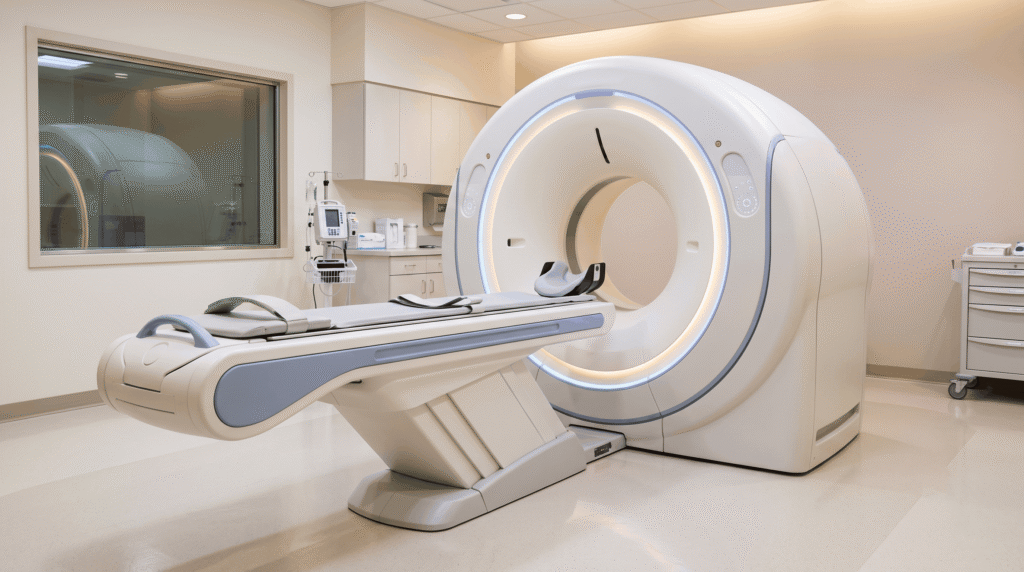
An MRI machine looks like a large tube with a padded table that slides inside. During the scan, the machine generates a magnetic field that temporarily aligns hydrogen atoms in your body. Radio waves are then sent through the body, and the signals produced are captured by the machine and converted into highly detailed images.
MRI is particularly good at producing clear images of soft tissues such as the brain, spinal cord, nerves, muscles, ligaments, tendons, and internal organs. It is widely considered one of the most detailed imaging methods available today.
A typical MRI scan takes 20 to 45 minutes depending on the body part being examined. The machine makes loud knocking and humming sounds during the scan, which are completely normal.
What Is a CT Scan?
CT stands for Computed Tomography. A CT scan uses X-rays taken from multiple angles around the body, which a computer then combines into detailed cross-sectional images (like slices of bread through the body).
A CT machine looks like a large doughnut-shaped ring. You lie on a table that slides through the ring while the X-ray tube rotates around you. The process is quick and painless.
CT scans are excellent at imaging bones, detecting bleeding, evaluating chest conditions, and providing fast, detailed pictures of internal injuries. They are frequently used in emergency medicine because of their speed.
A typical CT scan takes only 5 to 15 minutes, making it significantly faster than an MRI.
Key Differences Between MRI and CT Scan
The following comparison covers the most important differences between the two imaging methods.
Technology Used
MRI uses a magnetic field and radio waves. It does not involve any ionising radiation. CT uses X-rays, which means it does involve a small amount of ionising radiation. For most patients, the radiation dose from a single CT scan is low and considered safe, but this is one reason doctors weigh the benefits before ordering a CT, especially for repeated scans or for children and pregnant women.
Scan Duration
A CT scan is significantly faster. Most CT scans are completed in 5 to 15 minutes. An MRI typically takes 20 to 45 minutes, and some complex scans can take up to 60 minutes. For patients who have difficulty staying still (young children, elderly patients, or those in pain), the shorter CT scan time can be an advantage.
Radiation Exposure
MRI does not use radiation at all. This makes it a preferred option when repeated imaging is needed over time, such as monitoring a known condition, and when imaging children or pregnant women (though MRI during pregnancy is still used cautiously and only when medically necessary).
CT involves a low dose of ionising radiation. Modern CT machines use dose-reduction technology to keep exposure as low as reasonably achievable (a principle known as ALARA). For most patients, the diagnostic benefit of a medically necessary CT scan far outweighs the small radiation risk.
Cost Comparison
In general, a CT scan costs less than an MRI scan. The exact cost depends on the body part being scanned, whether contrast dye is used, and the specific diagnostic centre. In Bhubaneswar, both tests are available at competitive rates.
For current pricing at Shri Medscan, call +91 7440191919 (Damana Square) or +91 7440000180 (AIIMS Road).
| Feature | MRI Scan | CT Scan |
|---|---|---|
| Technology | Magnetic field + radio waves | X-rays (ionising radiation) |
| Radiation | None | Low dose (minimised with modern equipment) |
| Typical Duration | 20 to 45 minutes | 5 to 15 minutes |
| Best For | Brain, spine, joints, soft tissues, nerves, muscles | Bones, chest, abdomen, emergency injuries, bleeding |
| Contrast Dye | Gadolinium (if needed) | Iodine-based (if needed) |
| Relative Cost | Higher | Lower |
| Noise Level | Loud (earplugs provided) | Quiet |
| Enclosed Space | Yes (tube-shaped machine) | No (open ring shape) |
When Do Doctors Usually Recommend an MRI?
Doctors typically order an MRI when they need detailed images of soft tissues. Common situations include:
- Brain and spinal cord conditions (suspected stroke, tumours, multiple sclerosis, spinal disc problems)
- Joint injuries (ligament tears, cartilage damage, meniscus injuries in the knee)
- Muscle and tendon injuries
- Conditions affecting internal organs (liver, kidneys, heart)
- Monitoring conditions over time where repeated imaging without radiation is preferred
MRI provides exceptional contrast between different soft tissue types, which makes it the preferred choice for many neurological and musculoskeletal evaluations.
When Do Doctors Usually Recommend a CT Scan?
CT scans are often the first choice when speed is important or when doctors need to see bones and dense structures clearly. Common situations include:
- Bone fractures, especially complex fractures that are hard to see on a standard X-ray
- Chest conditions (lung infections, pulmonary embolism, pleural effusion)
- Abdominal and pelvic conditions (kidney stones, appendicitis, abdominal bleeding)
- Emergency situations (head injury, internal bleeding, accident trauma)
- Cancer staging and monitoring (when combined with contrast dye)
- Guiding procedures such as biopsies
The speed of a CT scan makes it invaluable in emergency departments, where fast imaging can directly affect treatment decisions.
Which Is Safer, MRI or CT Scan?
Both MRI and CT scans are considered safe when performed for a valid medical reason by qualified professionals.
MRI Safety Considerations
- No radiation exposure.
- Not suitable for patients with certain metal implants (some pacemakers, cochlear implants, metallic heart valves). The MRI team screens every patient before the scan.
- Gadolinium contrast (when used) is generally well tolerated. Patients with kidney problems require a pre-scan blood test to confirm kidney function.
- Claustrophobia can be a concern due to the enclosed tube design. Breathing techniques, earplugs, and mild sedation (prescribed by a doctor) can help.
CT Safety Considerations
- Involves a low dose of ionising radiation. Modern scanners use dose-reduction protocols to minimise exposure.
- Not routinely used for pregnant women unless the clinical benefit clearly outweighs the risk.
- Iodine-based contrast dye (when used) can cause allergic reactions in rare cases. The team screens for allergies before administering contrast.
- Generally better tolerated by claustrophobic patients due to its open-ring design.
In both cases, the imaging team at a qualified diagnostic centre like Shri Medscan follows strict safety protocols to protect every patient. The key point is that the decision to use MRI or CT is made by your doctor based on what is medically appropriate for your specific situation.
Can You Choose Your Own Scan?
While it is helpful to understand the differences between MRI and CT, the choice of imaging test is a clinical decision. Your doctor selects the scan that is most likely to provide the specific information needed to evaluate your condition.
Factors your doctor considers include the body part being examined, the type of tissue or structure that needs to be visualised, the urgency of the situation, your medical history (including implants, allergies, kidney function, and pregnancy), and the availability of equipment.
If your doctor has prescribed a specific scan, it is best to follow that recommendation. If you have questions or concerns about why a particular scan was chosen, do not hesitate to ask your doctor for an explanation.
MRI and CT Scans at Shri Medscan, Bhubaneswar
Shri Medscan Imaging Center offers both 1.5T MRI and advanced CT scanning at two locations in Bhubaneswar, Odisha:
Damana Square, Chandrasekharpur
Damana Square, Chandrasekharpur, Bhubaneswar 751021
Phone: +91 7440191919
View location details and directions →AIIMS Road, Patrapada
AIIMS Road, Patrapada, Bhubaneswar 751019
Phone: +91 7440000180
View location details and directions →All scans are reviewed and reported by qualified radiologists. Reports are typically available within 24 to 48 hours.
We also offer digital X-ray, ultrasound, pathology lab services, and a full range of diagnostic services.
Frequently Asked Questions
What is the main difference between MRI and CT scan?
MRI uses a magnetic field and radio waves to create images, while CT uses X-rays. MRI excels at showing soft tissues like the brain, spine, and joints. CT is faster and better at imaging bones, the chest, and emergency injuries. Neither test is universally better; the right choice depends on the clinical situation.
Which is safer, MRI or CT scan?
Both are safe when medically indicated. MRI does not use radiation, making it preferable for repeated imaging, children, and pregnant women. CT involves a low dose of radiation, which modern scanners minimise. Your doctor weighs the benefits and risks based on your specific needs.
Is MRI more expensive than CT scan?
Generally, yes. MRI costs more than CT due to the complexity of the technology and longer scan times. However, pricing varies by body part, contrast use, and the diagnostic centre. Call Shri Medscan at 7440191919 for current pricing in Bhubaneswar.
How long does each scan take?
A CT scan typically takes 5 to 15 minutes. An MRI scan takes 20 to 45 minutes, though some complex scans may take up to 60 minutes.
Can I choose between MRI and CT scan myself?
The choice of imaging test is a clinical decision made by your doctor. Your doctor selects the scan that is most appropriate for your specific condition. If you have questions about why a particular scan was recommended, ask your doctor for an explanation.
Do both scans use contrast dye?
Not always. Some MRI and CT scans require contrast dye to make certain structures more visible. MRI uses gadolinium-based contrast, while CT uses iodine-based contrast. Your doctor will specify if contrast is needed, and the team will screen you for allergies and kidney function before administering it.
Are MRI and CT scans available at Shri Medscan, Bhubaneswar?
Yes. Shri Medscan Imaging Center offers both 1.5T MRI and CT scanning at two locations in Bhubaneswar: Damana Square, Chandrasekharpur (7440191919) and AIIMS Road, Patrapada (7440000180). Same-day reporting is available.
Book Your MRI or CT Scan at Shri Medscan, Bhubaneswar
Experienced radiologists. Quick reports. Two convenient locations. Open 7 days a week.
Call Now: +91 7440191919 (Damana) | +91 7440000180 (AIIMS Road)
Book Your Appointment →
Disclaimer: This article is for informational purposes only. It is not a substitute for professional medical advice. The choice between MRI and CT scan is a clinical decision made by your treating doctor. Always consult your physician for guidance specific to your condition.
Medically reviewed by: Dr. Bhakta Charan Sahoo, MD (Radiodiagnosis), Shri Medscan Imaging Center, Bhubaneswar.