
Medically reviewed by: Dr. Bhakta Charan Sahoo, MD (Radiology), Shri Medscan Imaging Center, Bhubaneswar.
If your doctor has recommended an MRI scan, you may be wondering what to expect and how to get ready. MRI (Magnetic Resonance Imaging) is one of the safest and most detailed diagnostic tools available today. It uses a strong magnetic field and radio waves to create clear, detailed images of the inside of your body. There is no radiation involved.
Proper preparation helps ensure that your scan goes smoothly and that the images are as clear as possible. This guide covers everything you need to know before your MRI appointment, including what to wear, what to avoid, how to manage anxiety, and what to expect on the day of the scan.
This guide has been prepared by the radiology team at Shri Medscan Imaging Center, a diagnostic centre in Bhubaneswar, Odisha, offering 1.5T MRI scans at two convenient locations.
What Is an MRI Scan? A Brief Overview
An MRI scan creates highly detailed images of organs, bones, soft tissues, and blood vessels inside your body. Unlike X-rays or CT scans, MRI does not use ionising radiation. Instead, it uses a powerful magnet and radio frequency pulses to produce images.
MRI scans are commonly used to examine the brain, spine, joints, abdomen, pelvis, heart, and blood vessels. Your doctor may order an MRI to help evaluate an injury, investigate symptoms, or monitor a known condition.
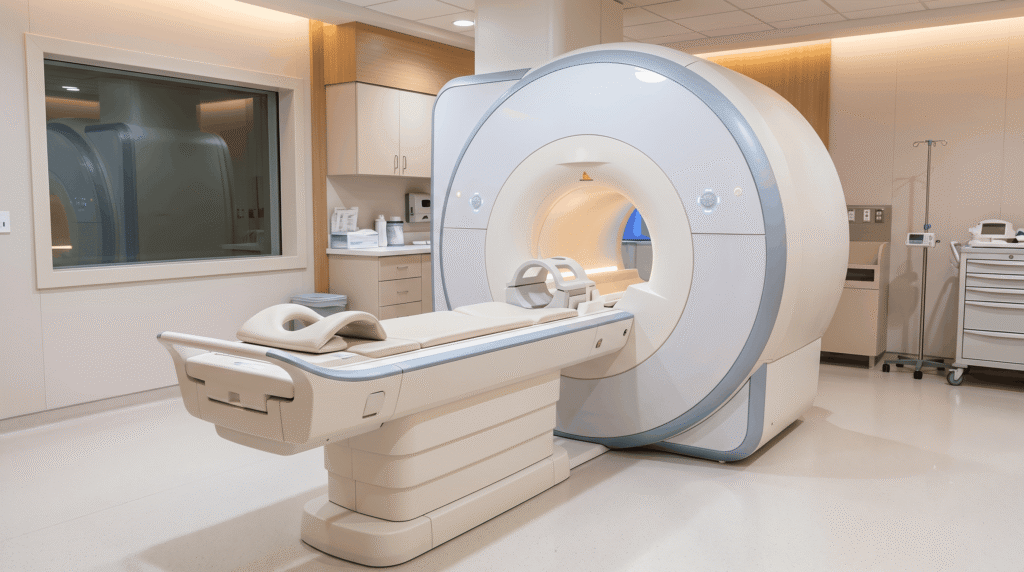
The scan is painless. You lie on a padded table that slides into a large, tunnel-shaped machine. The machine makes loud clicking and humming sounds during the scan, but these are completely normal.
How to Prepare for Your MRI Scan
Follow these preparation steps to help your scan go as smoothly as possible.
What to Wear (and What to Avoid)
The MRI machine uses a very strong magnetic field. Any metal on your body or clothing can interfere with the scan or create safety risks.
- Wear loose, comfortable clothing: Avoid metal zippers, buttons, hooks, or underwires. A plain cotton T-shirt and loose track pants work best.
- Remove all jewellery: Remove all rings, earrings, necklaces, bracelets, watches, and hair clips before arriving. It is best to leave valuables at home.
- Avoid clothing with metallic threads or prints: Some modern activewear, compression clothing, and printed designs contain metallic micro-elements that can warm up or blur scan data.
Many MRI centres, including Shri Medscan, provide a clean clinical hospital gown for you to change into. This eliminates any concerns about hidden metal in everyday clothing.
Can You Eat Before an MRI?
For most MRI scans, you can eat and drink normally before your appointment. There are no fasting requirements for a standard non-contrast MRI.
However, if your doctor has ordered an MRI with contrast (a special dye injected through a vein to make certain structures more visible), you may be asked to avoid eating for 2 to 4 hours before the scan to reduce the chance of nausea. When in doubt, call ahead and ask.
Metal Implants, Surgical Hardware, and Medical Devices
Because MRI uses a powerful magnet, certain metal objects inside your body can pose safety concerns. Before your scan, inform the MRI team if you have any of the following:
- Cardiac pacemaker or implantable defibrillator (ICD)
- Cochlear (ear) implants
- Metallic heart valves or vascular stents
- Surgical clips, pins, plates, or screws
- Metal fragments in your eyes (e.g., from welding or grinding work)
- Drug infusion pumps (insulin pump or pain pump)
- Neurostimulators or spinal cord stimulators
- Any other implanted electronic or metallic device
Not all metal implants are unsafe for MRI. Many modern joint replacements, titanium hardware, and dental fillings are MRI-compatible. Our team will review your surgical history to confirm safety before proceeding.
Medications: Should You Take Them Before the Scan?
In most cases, you should continue taking your regular medications on the day of the MRI with a small sip of water. However, always inform the MRI technician about all medications you are currently taking, including prescription drugs, over-the-counter supplements, and diabetes medication.
What Is MRI Contrast (Gadolinium) and Do You Need It?
Some MRI scans require a contrast agent called gadolinium, injected into a vein in your arm. Contrast helps certain tissues, blood vessels, and inflammatory abnormalities appear clearly on diagnostic monitors.
Before receiving contrast, the MRI team will ask about:
- Any history of allergic reactions to contrast agents
- Kidney function (a recent serum creatinine blood test is often checked, as gadolinium is cleared by the kidneys)
- Pregnancy or breastfeeding status
Managing Claustrophobia and Anxiety During an MRI
It is completely normal to feel nervous about lying inside the scanner, especially if you experience claustrophobia. Here are practical tips to keep you calm:
- Talk to the MRI team beforehand: Let the technician know you are anxious. They are trained to guide you through every step.
- Close your eyes before entering: Closing your eyes before the table slides into the bore avoids the visual trigger of the enclosed space.
- Focus on your breathing: Try box-breathing (inhale for 4 seconds, hold for 4 seconds, exhale for 4 seconds).
- Music or headphones: We provide headphones and ear protection to reduce machine knocking sounds.
- Use the emergency squeeze ball: You will hold a call button throughout the scan. Pressing it alerts the technician immediately to pause or communicate.
On the Day of Your MRI Scan: What to Expect
Step 1: Arrive Early
Arrive 15 to 20 minutes before your scheduled appointment to complete clinical registration and the safety screening questionnaire.
Step 2: Safety Screening
You will complete a questionnaire detailing medical implants, allergies, previous surgeries, and pregnancy status.
Step 3: Changing and Locker
You will remove metallic accessories and change into a gown if needed. A secure locker is provided for your valuables.
Step 4: The Scan
You will lie still on the padded table for 20 to 45 minutes while the scanner captures high-resolution slices.
Step 5: After the Scan
You can resume your normal routine, work, and diet immediately. Reports are verified and delivered within 24 to 48 hours.
Quick MRI Preparation Checklist
Preparation Checklist:
- Confirm your appointment date, time, and centre location.
- Ask your doctor whether fasting or contrast dye is required.
- Wear comfortable, loose cotton clothing with zero metal.
- Remove all jewellery, watches, hairpins, and metallic accessories.
- Bring your doctor’s referral letter and previous diagnostic films.
- Bring a valid government ID.
- Inform the MRI team about any pacemakers, clips, or implants.
- Provide a list of current daily medications.
- Arrange for someone to accompany you if you requested a mild sedative.
Where to Get an MRI Scan in Bhubaneswar
Shri Medscan Imaging Center offers high-precision 1.5T MRI scans at two convenient centres in Bhubaneswar:
Damana Square Centre
Damana Square, Chandrasekharpur, Bhubaneswar 751021
Phone: +91 7440191919
View location details & directions →AIIMS Road Centre
AIIMS Road, Patrapada, Bhubaneswar 751019
Phone: +91 7440000180
View location details & directions →Learn more about scan varieties, pricing, and reporting on our dedicated MRI Scan in Bhubaneswar service page. If your doctor has also recommended alternative imaging, we provide low-dose CT scans, Digital X-Ray, Ultrasound, and comprehensive diagnostic services.
Frequently Asked Questions About MRI Preparation
Can I eat before an MRI scan?
For most routine MRI scans, yes. You can eat and drink normally. If your scan requires contrast dye, you may be asked to avoid eating for 2 to 4 hours beforehand.
What should I wear for an MRI?
Wear loose, comfortable clothing without metal zippers, buttons, or underwires. A plain cotton T-shirt and track pants work well, or you can change into our sanitized clinical gowns.
Can I have an MRI if I have a metal implant?
It depends on the implant type. Many modern joint replacements and dental fillings are MRI-compatible. However, older pacemakers and certain cochlear implants are contraindicated. Always inform our team prior to testing.
How long does an MRI scan take?
A typical scan takes 20 to 45 minutes depending on the body part examined. Complex multi-region studies can take up to 60 minutes.
Is MRI safe during pregnancy?
MRI does not use radiation and is generally safe during pregnancy. However, contrast dye (gadolinium) is usually avoided unless medically essential.
What if I feel claustrophobic during the scan?
Let our technician know in advance. We provide headphones, continuous check-ins, and an emergency squeeze bulb so you remain in control throughout.
Will I get my MRI report the same day?
At Shri Medscan, MRI reports are typically available within 24 to 48 hours following thorough evaluation by our consultant radiologists.
Ready to Book Your MRI Scan?
Get a high-precision 1.5T MRI scan at Shri Medscan Imaging Center, Bhubaneswar. Experienced radiologists, quick reporting, and two convenient locations.
Call Now: +91 7440191919 (Damana) | +91 7440000180 (AIIMS Road)
Book Your Appointment →
Disclaimer: This article is for informational purposes only and does not substitute for medical advice. Always consult your doctor for guidance specific to your health.
Medically reviewed by: Dr. Bhakta Charan Sahoo, MD (Radiology), Shri Medscan Imaging Center, Bhubaneswar.